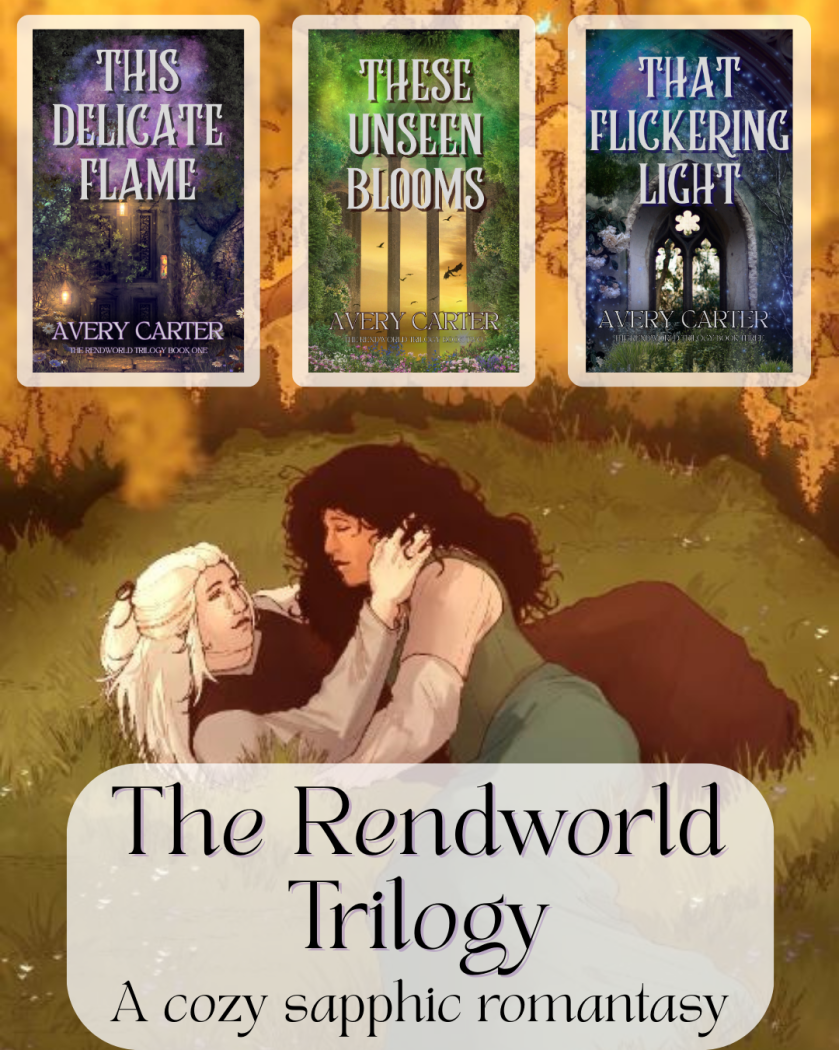
Last year, I gave myself a challenge. It was an extremely difficult challenge, but one I knew I could handle with the proper amount of planning and care. I wanted to write and release an entire fantasy trilogy in one year. I had an inkling of a story– a grumpy healer, and the assassin who shows up on her doorstep.
And then the grumpy healer sat back, with her hands folded, and said “Say please.” Right there, I knew I was working on something special. Of course, at the time, I didn’t know just how special it would become. But I’m getting ahead of myself.
This Delicate Flame was released March 30th 2025. I had a solid number of preorders, and a good ARC list. It released, and people loved it. It was praised for its unique fantasy elements (rainbow forest my beloved), its botanical illustrations, but most of all, Rylla’s character. Her way of looking at the world, and her very obvious autism. I put a lot of myself and my own experiences into her, and the fact that so many people resonated with the character was empowering and made me feel so seen and understood. Much of Rylla’s love for plants and healing comes from The Prison Healer, and The Apothecary Diaries. Between those and the Arcane season 2 soundtrack, it was easy to put the story to paper.
Then it was time for book 2.
These Unseen Blooms was a difficult drafting process, but the book turned out to be something I’m so proud of. My favorite part to write was obviously the dragons. They’re so needlessly formal and ceremonial about everything. I knew my dragons would be functionally immortal, so I wanted to give them a few things to be extremely picky about. First: food. I watched The Menu and was struck by the absolute ridiculousness of high-class foodie culture. I knew immediately that I wanted my dragons to treat food in a similar way. Balancing that with Rylla’s autism was a great way to highlight some of the difficulties that come from food textures. The second thing I wanted them to be picky about was language. When I was a teenager, I read The Obsidian Trilogy and loved how the elves never asked questions. They would talk about nothing for hours as part of their polite pleasantries before actually getting to the point. I borrowed part of that to write my own dragons, and I think it helped make them feel unique without being too different from genre conventions.
Of course, I have to take a moment to talk about Ceri. Dear, damaged Ceri. From her inception, I knew she would be the narrative foil for Tarinne. More accurately, she would be who Tarinne was without Rylla. She would be the first one to offer Tarinne her old life. She was incredibly fun to write, and I loved the little window she gave into Tarinne’s past.
I can’t talk about side characters without mentioning Ben, Alre, Nairra, or Fenn. The problem is, there’s so much to say. There’s three novellas in those characters alone. How Nairra and Fenn met and fell in love, Ceri’s post-trilogy adventure, and Ben trying to help Alre woo the kingdom’s new queen. Someday, when I release the hardcover omnibus of the trilogy, those novellas will be inside.
I digress. Book 3.
That Flickering Light was the hardest to write. All of the characters were in such dark places. They went through so many awful things, and all I wanted was for them to have their happy ending. But they had to earn it, and earn it they did. There were a lot of things I wanted to accomplish with the ending, but the most important part to me was when Tarinne was offered a better version of her old life. She would have the freedom she craved, and she would be able to help others who were in the same position she was in. She looked at this life, and said no. No, I’m going to Woodhaerst with Rylla. I choose peace. That was the most powerful thing she could have done in that moment.
I cried when I wrote the ending. Knowing I had brought these women through so much, and they finally got the peace they deserved… it was emotional. Book 3 was released into the world, and I sat back and waited to see what would happen. I was scared. I was excited. I didn’t know what was about to happen.
I didn’t know my book sales would triple.
I didn’t know I would smash past 50 reviews on This Delicate Flame.
I didn’t know I would be on so many people’s “Best Books of 2025” lists.
I didn’t know I would meet so many author and reader friends.
Writing and publishing these books in one year was the biggest challenge I have ever taken on, but the reception I’ve gotten for these books… wow. I am so excited to see what comes next. I have a feeling it’s going to be sweet 😉
 Avery Carter